A range is two appliances sharing a cabinet, and they rarely fail together. Most of our cooking calls in Los Angeles are either “the oven is off by 50 degrees” or “one burner will not light” — and the diagnosis for each has almost nothing in common with the other. We service both halves on the same visit, whether they live in one range or in a separate wall oven and cooktop.
Ovens usually fail slowly. Cakes brown on one side, a roast takes twenty minutes longer than it used to, the temperature light cycles at odd moments. Most people adapt to it for a year before calling anyone — and by then they have often replaced a perfectly good oven over a failed temperature sensor. The first thing we do is measure: a calibrated thermocouple in the cavity tells us immediately whether the oven is off by 5 degrees or 60.
Pro-style ranges are their own category. A 48-inch Wolf, Viking, Thermador, La Cornue or Bertazzoni is built to be rebuilt, and parts remain available for decades. These jobs go to technicians who work those platforms daily, because the burner assemblies, ignition systems and oven controls have nothing in common with a mass-market slide-in.
If you can smell gas: do not use the appliance, do not switch anything electrical, open a window and call the gas company from outside. Once the supply is confirmed safe, we will handle the appliance side.
Common oven problems we fix
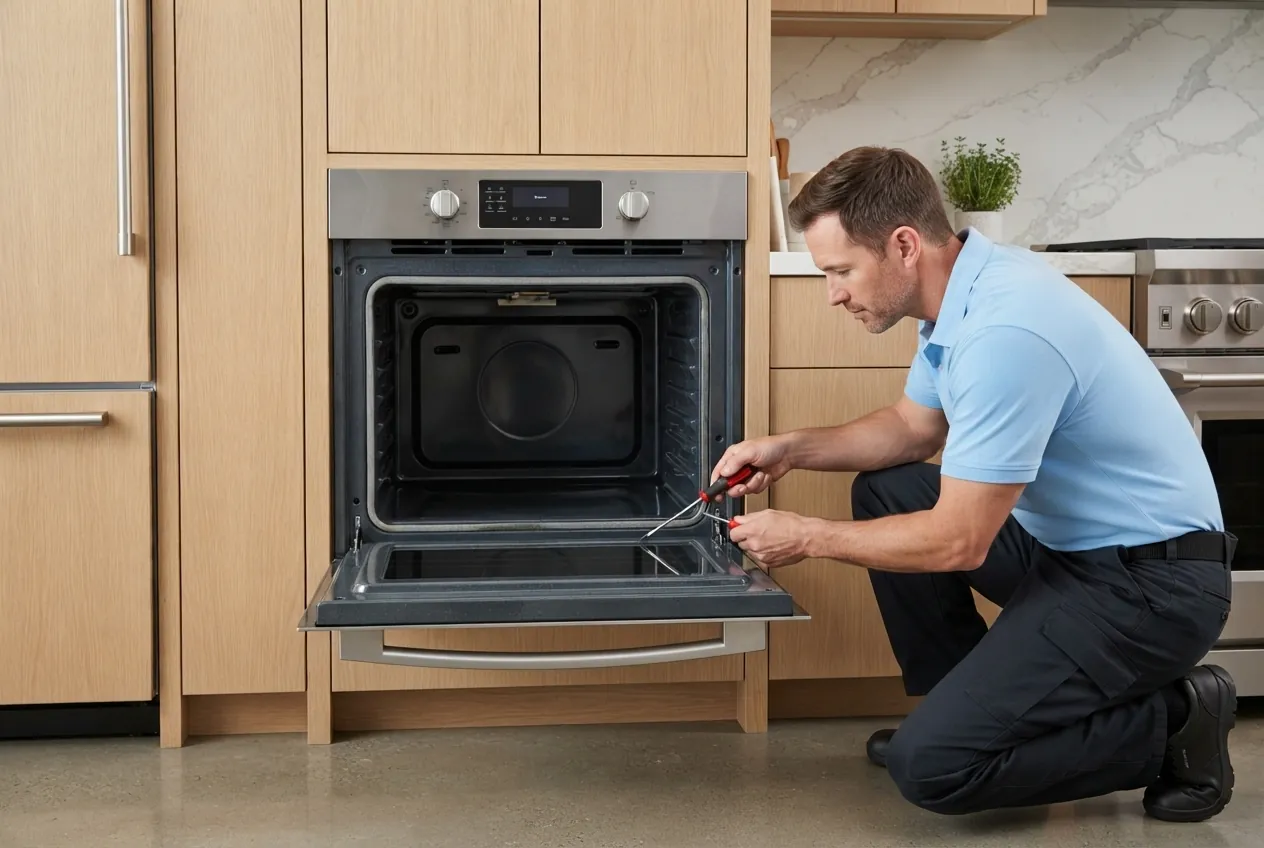
- Baking unevenly. A failing bake element, a convection fan that has stopped, or a door seal leaking heat from one corner.
- Not reaching the set temperature. The oven temperature sensor drifting out of range, or a thermostat that needs recalibrating. Inexpensive parts, dramatic difference.
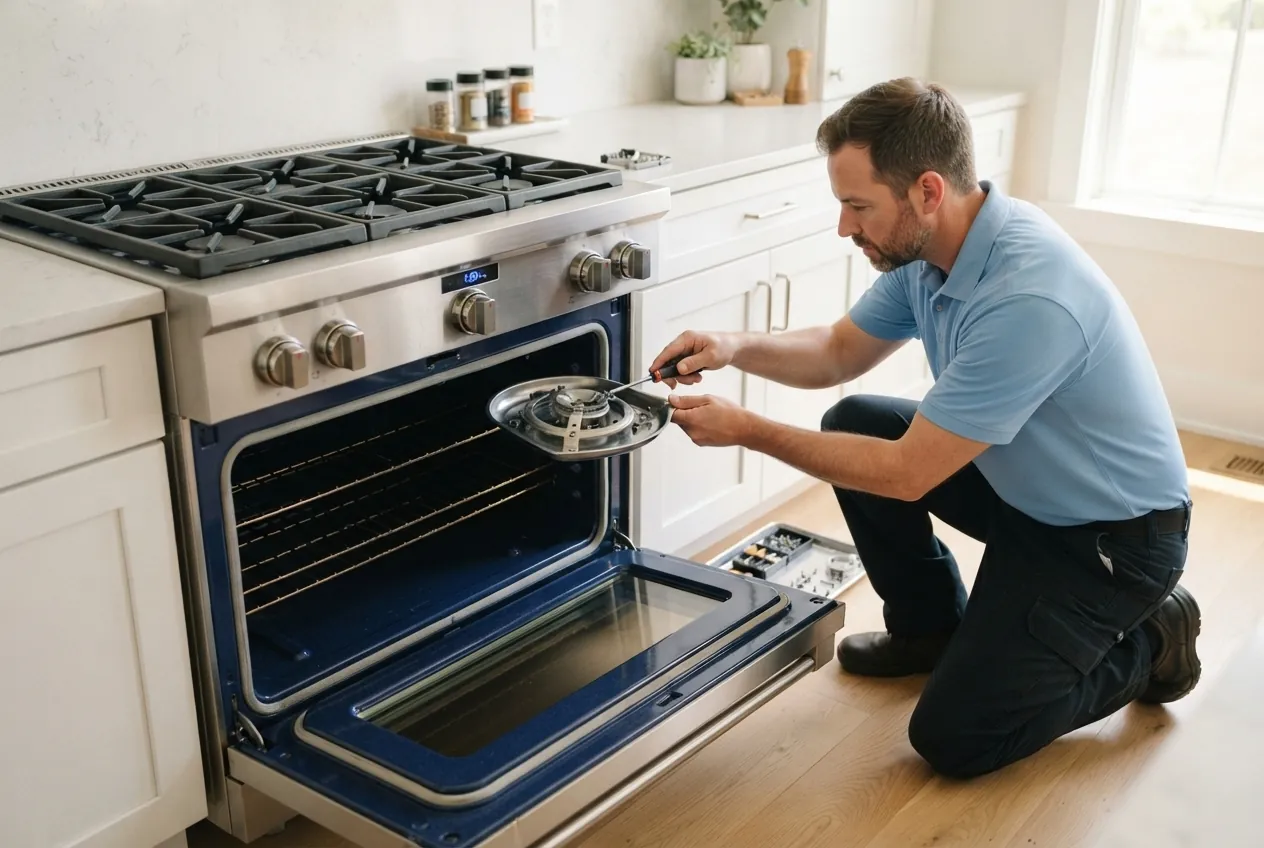
- Gas oven will not ignite. The igniter, almost always. It weakens gradually, so the oven takes longer and longer to light before it stops entirely.
- Electric oven with no heat. A broken bake or broil element, often visible as a blister or break in the coil, or a failed relay on the control board.
- Door locked after a self-clean cycle. A very common call. The thermal cut-out or the lock motor has failed — self-clean runs hot enough to kill both, which is why we suggest using it sparingly.
- Convection fan noisy or stopped. The motor or its mount. It also explains uneven baking that no calibration will fix.
- Display dead or showing an error. Control board or membrane switch. We verify the code against the actual component before ordering anything.
Common cooktop and burner problems we fix
- Clicking but not lighting. A wet or misaligned igniter, or food debris bridging the electrode. Drying and cleaning it fixes most of these outright.
- Yellow or uneven flame. Blocked burner ports, a misaligned cap, or an air shutter out of adjustment. A correct flame is blue and steady — yellow means incomplete combustion and should be corrected.
- One burner dead, the rest fine. The spark module, switch or electrode for that position rather than the whole cooktop.
- Simmer burner that will not hold low. On pro ranges this is an adjustment as often as a fault, and it is worth having set properly.
- Electric element not heating. The element itself, the infinite switch, or a burned receptacle block on plug-in coil types.
- Induction zone cutting out. Usually overheating, from blocked ventilation underneath or a failing cooling fan — not the coil.
- Cracked glass or ceramic top. Stop using it and book. A crack lets spills reach the wiring underneath.
Cooking equipment we service
- Freestanding and slide-in ranges — gas, electric and dual-fuel
- 30, 36, 48 and 60-inch professional ranges, including griddle and French-top modules
- Single and double wall ovens, convection, steam and combination-steam
- Speed ovens and built-in microwave-oven combinations
- Gas, electric radiant, ceramic and induction cooktops, including downdraft models
- Luxury platforms: Wolf, Viking, Thermador, La Cornue, Bertazzoni, Miele, Dacor, Monogram, JennAir
Range & Oven Repair FAQ
My oven runs cold. Can it just be recalibrated?
Often yes — most ovens have an offset adjustment of around 35 degrees either way. If the drift is larger than that, the temperature sensor has failed and recalibrating only hides it. We calibrate on every cooking call as standard.
Should I use the self-clean cycle?
Sparingly. It runs the cavity up near 900°F, and that heat is what kills door locks, thermal fuses and control boards. Once or twice a year at most, and never the day before you need the oven.
The igniter glows but the gas never lights. Why?
A weak igniter still glows but no longer draws enough current to open the safety valve. It is the single most common gas oven repair and it is straightforward.
My burner clicks constantly, even when it is off. Is that dangerous?
Not dangerous, but do turn the cooktop off at the wall if it will not stop. It is almost always moisture or debris around an electrode after a spill, and it clears once everything dries out properly.
My oven and cooktop both stopped at once. One fault or two?
On a dual-fuel range, usually one: a supply or control board issue affecting both. On a straight gas range, more often two unrelated faults that happened to surface together.
Do you work on built-in wall ovens and move heavy ranges?
Yes to both. Wall ovens often have to be drawn out of the cabinetry, and pro ranges are heavy on tile or hardwood that marks easily — so we protect the floor, use rollers rather than dragging, and book the time (and where needed the second technician) that requires.
Other appliances we repair
- Refrigerator & freezer repair
- Dishwasher repair
- Washer repair
- Dryer repair
- Ice maker repair
- Wine cooler repair
- Coffee maker repair
Every appliance we cover is listed on the services page.